

Returns Management: The Hidden Cost of Letting Returns Sit
By Maurice Greenberg, Managing Partner, SJM ReCommerce

An unprocessed return costs you twice. The product depreciates every day it sits, and the data inside it (why it came back, what failed, how many others failed the same way) disappears just as fast. Wait too long, and the unit gets liquidated, taking that information with it for good. Top operations process returns in 3 to 5 days; slow ones take two to three weeks and eat the difference. Move fast and you keep both the value and the intelligence.
Every day a return sits in the corner of your warehouse, it costs you a little more. The product itself loses value as it depreciates, misses its season, and picks up damage from being shuffled around the floor. At the same time, the information inside it quietly disappears. Most brands keep a close eye on the first cost and barely register the second. We handle returns for brands like Craftsman and Sun Joe, so we watch both meters run every day.
Cost #1: The product depreciates every day it sits
A return is not a static asset. The moment it comes back it starts losing value, and the longer it goes unprocessed, the faster that decline runs. Four things tend to happen at once.
- Seasonality: A snow blower that comes back in November and does not get processed until March has missed its entire selling window. For outdoor power equipment, that is a full year of recovery value gone.
- Market drift: Newer models launch and prices move. A unit that could have sold through a certified refurbished channel near full price in week one becomes a liquidation candidate by month three.
- Physical damage: Returns that pile up get shuffled around to make room for outbound. Every time a unit in already-compromised packaging gets moved, the damage gets worse. What was cosmetic becomes structural, and what was Grade B becomes scrap.
- Shrinkage: Piles get picked through, case packs get opened, and batteries, chargers, and accessories go missing. A return that arrived complete leaves the pile incomplete, and if nobody logged it at the unit level, nobody ever noticed.
Speed is what protects against all four of these, and the window is tighter than most brands assume. According to logistics analysis compiled by JIT Transportation in 2025, top-performing returns operations complete the full cycle from receipt to restock in 3 to 5 days, while slower ones take two to three weeks. That gap is where the money goes. McKinsey's 2026 research puts a number on it: a return run through a slow, default process recovers only about 50 percent of an item's worth, while one routed quickly recovers closer to 75 percent. That's the difference between dumping it in a liquidation lot and selling it as refurbished.
Cost #2: What happens to the intelligence inside the return?
This is the cost almost nobody tracks. Every return carries information about why it came back. What condition it is in, packaging that failed, a missing component, the third one this month with the same problem. If returns are not processed quickly and logged at the unit level, none of that gets captured. Once it's gone, it's gone. You cannot inspect a return you liquidated three months ago.
The real value is in the patterns you can only catch while the units are still in front of you.
- Defect patterns: One return with a circuit board failure is a warranty claim. Ten of the same failure on the same model is a manufacturer defect you want to catch before it goes public.
- Listing problems: A spike in “didn’t match the description” returns is usually pointing at the product listing, not the product itself.
- The intentional rental: Some items are bought for one job and sent back when it is done. No defect, no complaint. That only shows up as a pattern if someone is tracking return reasons closely enough to see it, and it changes how you write policy and listings.
- Packaging and freight failures: A single cracked housing is bad luck. A run of cracked housings on the same SKU points to a packaging problem you need to fix at the source.
At SJM we log every return by retailer, date, condition, return reason, and missing components. We then slice that data across product lines and models so the patterns surface fast. That organization is what lets you catch the difference between a one-off return and a real, nationwide problem. Each one calls for a different response.
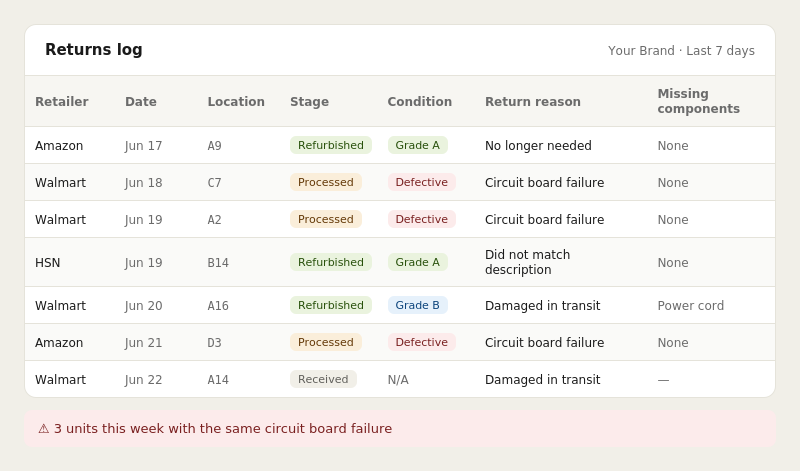
What does this look like in practice?
These are not hypotheticals. This is what catching returns early has meant for brands we work with.
Cub Cadet, LTL freight damage. Units were coming back as "damaged in transit," and when each one was logged as its own isolated claim, the whole thing looked random. Once we started tracking it systematically at the unit level, the real story showed up. The damage was not a product defect or random bad luck. It was an LTL freight packaging failure. We documented the pattern and re-crated the affected units in our facility so they could ship without running into the same problem. Then we handed Cub Cadet the data they needed to fix it at the source. The damage stopped repeating.
Snow Joe, a defect caught before it spread. One snow blower model kept coming back with the same circuit board failure, over and over. As we worked through the returns and refurbishing process, we documented exactly what we were finding, unit by unit, and brought it to Snow Joe. Because the data was there in time, they were able to pull that model quietly before it grew into a larger public problem. No formal recall, no brand exposure, just a fast decision made on good information. That same discipline is why the wider Snow Joe / Sun Joe brand trusts us with their returns and refurbishing. You can see the full Snow Joe / Sun Joe case study walkthrough here.
Duraflame, a pattern that was not about quality at all. Heater returns started spiking, and on the surface that looked like a product problem worth worrying about. But the data told a different story. The units were selling when the temperature dropped and coming back once the weather warmed up. People were buying them for a cold snap, using them, and returning them when they no longer needed the heat. That is not a defect to refurbish around. It is a behavioral pattern. Recognizing it turned the conversation toward return policy and channel strategy, instead of sending the team chasing a quality issue that did not exist.
What to do next
If returns are sitting in your operation longer than a week before anyone touches them, both meters are running. The asset is depreciating and the intelligence is evaporating.
That's the core of our Returns Management service: process fast enough to protect the value, and log everything at the unit level so you capture the intelligence too. Send us your product category and rough monthly return volume, and we'll show you where your value is leaking now, what patterns are probably hiding in your return data, and what faster processing would recover on both sides.
Contact us to start.